01Introduction
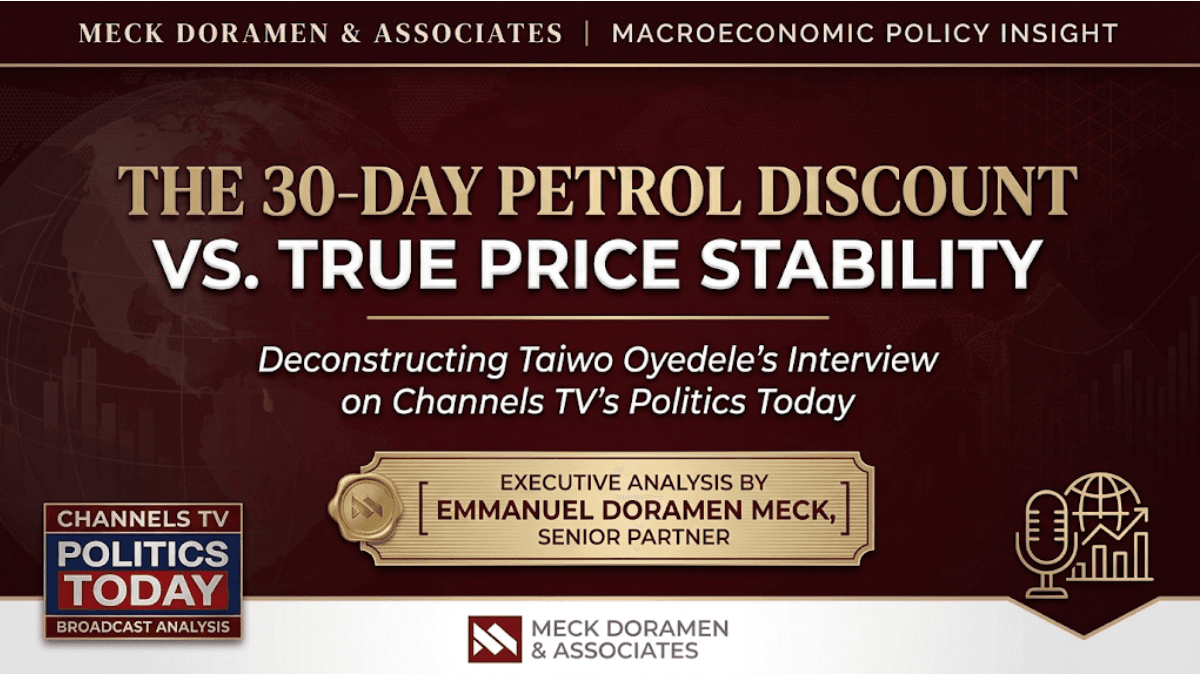
When the Minister of Finance and Coordinating Minister of the Economy, Mr. Taiwo Oyedele, recently sat down on Channels Television’s Politics Today with Seun Okinbaloye, boardroom executives across the country paid keen attention. From the industrial layouts of Ikeja and Kano to the commercial corridors of Port Harcourt, Lagos, and Abuja, business leaders listened intently as the Minister sought to explain the Federal Government’s newly announced 30-day discount on Premium Motor Spirit (PMS) dispensed through NNPC Limited retail outlets.
The announcement immediately sparked heated debates across the private sector: Is the Federal Government quietly reintroducing the controversial fuel subsidy through the back door? Will this price reduction provide meaningful operational relief to businesses battling double-digit inflation? And if the macroeconomic environment remains fragile, why shouldn't the government simply return to a structured, predictable subsidy framework?
Addressing these questions requires looking past political soundbites to examine the underlying financial mechanics, evaluate the policy's impact on corporate balance sheets, and determine what this signals for enterprise sustainability in Nigeria.
02Decoding the Policy: Discount Concession vs. Fiscal Subsidy
During his interview on Politics Today, Mr. Oyedele was emphatic: this 30-day price reduction is a temporary commercial discount, not a return to the petrol subsidy regime.
To understand the distinction, one must examine how both mechanisms affect government finances and fuel markets;
1. Under a Classic Fuel Subsidy Regime: The Federal Government injects direct budgetary allocations or incurs under-recovery liabilities to absorb the difference between the actual landed cost of imported fuel and an artificially suppressed pump price. This creates a permanent fiscal burden, inflates national debt, and drains revenue that should fund public infrastructure
2. Under the 30-Day Retail Discount Framework The government is not issuing direct cash payouts from the federation account. Instead, NNPC Retail is temporarily foregoing its commercial profit margins to dispense petrol at landed cost for a limited 30-day period. This initiative targets public transport operators and major commercial transport arteries to mitigate immediate commuting costs.
Alongside this 30-day concession, the Ministry of Finance proposed an ex-gantry price ceiling framework (aimed around ₦1,350/litre) intended to cushion the domestic market against sudden spikes in international crude oil prices and foreign exchange fluctuations.
03Will the Policy Have Any Significant Impact on Nigerian Businesses?
While consumer advocacy groups may welcome any brief price relief at the pump, the reality for mid-market enterprises, manufacturing firms, and logistics providers is clear: this 30-day discount will have virtually no structural impact on corporate performance.
Here is a detailed breakdown of why this temporary measure falls short for corporate Nigeria;
1. The 30-Day Window Is Too Brief for Strategic Planning: In corporate finance and capital budgeting, 30 days is a drop in the ocean. Managing Directors, CFOs, and financial controllers do not adjust operational budgets, re-negotiate vendor contracts, or alter pricing structures based on a four-week window. Because the discount is explicitly temporary, prudent finance teams must keep baseline fuel expenses modeled at full market rates to prevent severe cash flow shocks on Day 31.
2. Distribution Bottlenecks and Operational Downtime: Restricting discounted petrol primarily to NNPC-owned stations creates immediate distribution hurdles. When discounted fuel is limited to specific retail stations, long queues form quickly. The hours delivery trucks, sales fleets, and service vehicles spend idling in fuel queues result in lost productivity and operational delays that far outweigh any modest savings on pump price.
3. It Ignores Commercial Energy Demand (Automotive Gas Oil): Commercial operations across Nigeria rely primarily on Automotive Gas Oil (diesel) and industrial gas to power heavy delivery trucks, manufacturing plants, and off-grid generators. A short-term marginal discount on Premium Motor Spirit (PMS) at retail stations does not lower the cost of industrial diesel or heavy transport logistics, leaving the core energy expense drivers for productive industries unchanged.
4. Precautionary Pricing by Vendors and Retailers: Price setting across Nigerian supply chains is notoriously sticky downwards. Distributors, raw material suppliers, and service providers who adjusted their prices upward during previous fuel price increases will not revise their tariffs downward for a 30-day window. They understand that once the concession ends, fuel prices will adjust back upward, making any mid-stream price reductions commercially risky.
04Why Should Government Not Return to Fuel Subsidies?
Faced with rising operational costs and squeezed household budgets, some business owners ask: If a 30-day discount is insufficient, why doesn't the government simply bring back fuel subsidies to guarantee price stability?
As Mr. Oyedele highlighted during his interview, returning to a blanket fuel subsidy regime would be a severe economic misstep
Fuel subsidies function as a short-term palliative that creates long-term structural weakness. The trillions of Naira historically spent on price suppression starved the country of vital capital needed for grid upgrades, transport infrastructure, and social services. Reinstating subsidies would distort energy pricing, discourage private capital investment in domestic refining and renewable energy, and trigger fresh fiscal deficits that ultimately weaken the Naira.
05Applying the Policy to the Meck Doramen Advisory Framework
At Meck Doramen & Associates, our corporate finance and financial advisory practice helps mid-market enterprises build operational resilience amidst macroeconomic shifts. When evaluating client financial models, business valuations, or investment readiness proposals, our team explicitly advises corporate boards never to build operational models around short-term government interventions.
When advising corporate leadership on capital allocation, risk management, and working capital optimization, our advisory framework emphasizes structural adjustments;
1. Stress-Testing Financial Models: When preparing sell-side valuation dossiers or capital-raising models, we strip out temporary palliatives and price concessions. Cash flows are stress-tested against unadjusted international energy benchmarks and forward foreign exchange curves to ensure long-term solvency
2. Working Capital Protection: A 30-day fuel discount does not resolve a 90-day cash conversion cycle. We assist Managing Directors in streamlining receivables collection, removing working capital bottlenecks, and optimizing inventory levels so their businesses maintain cash buffers during price adjustments
3. Transitioning to Sustainable Energy Infrastructure: We advise corporate clients to reallocate expansion CapEx away from total reliance on public petrol and diesel markets. Investing in captive solar-hybrid systems, energy-efficient machinery, and direct gas pipeline connections provides lasting protection against energy market volatility
06Macroeconomic Implications for the Nigerian Economy
The Finance Minister’s interview highlights a key structural reality: Nigeria is undergoing a challenging transition from an artificially price-controlled economy to a market-driven environment.
The broader macroeconomic implications of this policy shift are clear;
1. Persistent Precautionary Inflation: Because temporary discounts do not alter the underlying cost of industrial production or bulk transport, headline inflation will remain sticky. Businesses will maintain precautionary margins to shield themselves from future price adjustments
2. Accepting Market-Reflective Pricing: The move toward price-smoothing frameworks rather than direct cash subsidies confirms that market-reflective pricing is here to stay. Enterprise survival will depend on internal efficiency, cost control, and financial discipline rather than public price interventions
3. The Imperative for Deep Structural Reforms: Lasting relief for Nigerian businesses and consumers will not come from short-term retail discounts. It requires expanding domestic refining capacity, modernizing rail networks, reducing grid power tariffs, and improving foreign exchange liquidity
07Conclusion
For business owners, corporate directors, and investors across Nigeria, the conclusion from Mr. Oyedele's interview is clear: do not build your business strategy around temporary market concessions. Sustainable enterprise growth requires building a lean, efficient, and stress-tested business model capable of thriving in a fully market-driven economy.